I’ve been seeing an increase in posts proclaiming the Go VeganTM gospel in response to the burning of the Amazon rainforest and I have some Thoughts.
First, support the indigenous work on the ground in Brazil –
https://www.fundopodaali.org.br/
The Go VeganTM rhetoric I’ve been seeing on Instagram, specifically in response to corporate greed leading to burning the Amazon, rings of colonialism, ableism, classism, and the “Urban Mindset” (I don’t really have another term for this?).
- Colonialism – Ranching/herding, hunting, and fishing has been accomplished sustainably by indigenous cultures since time immemorial. It’s also culturally important to those cultures that are still thriving and reinvigorating themselves. It seems ignorant to say Go Vegan to coastal/island communities where fish are so important in the culture and diet, to where sustainable hunting of deer/rabbit/etc in the forest is important in the culture and diet, to where the dependence on reindeer/cattle/nomadic herd animals is important in the culture and diet, etc. Also, especially for indigenous communities in North America, a lot of the food culture and knowledge was stolen and destroyed with colonialism. Not all crops grow in all places and the historical crop production and foraging information for much of North America is lost or unknown because of our governments’ and ancestors’ active genocide of native culture and the homogeneity in modern farming. (There are a lot of indigenous food culture revival movements currently happening, check out the Toasted Sister podcast for some really great interviews with native food folks in the Americas, but these movements are not necessarily open to non-natives and they have every right to be closed.)(Also look up the varieties of corn and compare that to what you can buy in your grocery store.)
- Ableism – Not everyone CAN physically or mentally make the change to a vegan diet. There are any number of things that can affect diet requirements – allergies, intolerances, gut health, mouth/teeth health, how an individual’s body processes fats/sugars, food textures, eating disorders, physical capability… I mean, “just” depression can make it hard to eat food regularly, never mind the content of those meals/snacks until that person’s mental health improves.
- Classism – Not everyone can afford to go vegan. I’ll go into this more in the “Urban Mindset” section, but vegetables** are not universally available. Food deserts exist. If grocery stores don’t or can’t afford to (i.e. bodegas, mom + pop grocers, etc) supply vegetables in your area, you can’t go vegan. If grocery stores supply vegetables at a higher cost than you can afford, you can’t go vegan. Homeless folks cannot access food reliably, never mind a vegan diet. Hell, many places, including cities and native reservations in the US and Canada- affluent countries, cannot even drink the water safely. Those communities do not have the same access to vegetables as wealthier communities. Subsistence hunting, ranching, and fishing is still a major way that people get their food.
- The “Urban Mindset” – A lot of the talk revolving around Saving The PlanetTM are very urban centric. Not everyone lives somewhere where you can get to a well-stocked grocery store in a reasonable amount of time. Subsistence ranching, hunting, and fishing is often necessary in rural communities. People can and do farm vegetables and grain, but those are seasonal and if the nearest grocery store is several hours away by car (if you even have a car), then winter/dry season/not growing season is going to be a light on vegetables in order to make those winter/dry season/not growing season preserves last until the growing season returns. Also, not all communities are in areas with long growing seasons or in areas with “good” soil. It’s hard to grow soy in northern Canada, Alaska, Siberia, etc. If you don’t live in a city that far north, your diet likely depends on fish and meat. (That’s an example – there are obviously other places where the growing season is short/hard because of other environmental factors.)
**I’m using vegetables as a catch all, since most of the things I’ve seen VegansTM preach about are a variety of vegetable substitutes, but also non-local herbs, seeds, nuts, mushrooms, grains, etc. will follow the same availability patterns as fresh veg.
My experience is as a white person in a pretty well-off family in the US in a semi-suburban area (used to be more rural when I was a kid, now is pretty suburban), so I have blind spots in regards to other communities around the world, but these are the things that have been pointed out to me via BIPOC response posts on IG and indigenous podcasts in response to ongoing native food and health reclamation work. There are entire continents where I don’t know enough about the food and farming cultures there to point out the issues with the Go VeganTM response (namely Africa, huge swathes of Asia, and I barely understand Australian climate zones).
It’s fine if you’re vegan and you want to share your diet or recipes with people looking to make that change or expand their food choices. It’s fine if you look at the affluent white, able friends you have and suggest maybe less meat to stop supporting factory farming. Maybe suggest local rancher/butchers who supply local sustainable meat or local chicken folks for eggs for the environmental factor, if your affluent white, able friends are opposed to full vegan or vegetarian. Feel free to post about your personal reasons for changing your diet! But the proclamations being passed around feel like *shaming*-
-which does not help folks who don’t have the health/monetary privilege to afford a vegan diet
-which does not help the exploitation of workers and wage issues (and the white supremacy within those structures that cause an increased affect for BIPOC workers) (money=choices)
– which does not help the spread of misinformation about what harms animals that have already been historically bred to need our help to live and are treated well by non-factory farms (sheep/wool, chicken/eggs, cows/milk) or naturally need intervention (honey bees/honey)
-which does not help folks just scraping by day by day, mentally and/or physically
-which does not improve access to and advancement in health care so that more people can make food choices
-which does not change the “diet” culture and fatphobia in Western society that causes disordered eating
-which does not gain universal access to food
-which does not help grassroots food communities
-which does not stop exploitation of indigenous land and peoples in farming and food production
-which does not stop slavery in agriculture
-and which does not dismantle the systems and power in place that has led to this event.

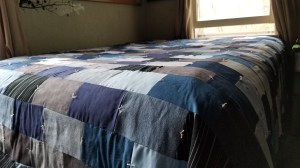 The Winter Wall quilt was made adapting a pattern of the same name from The Weekend Quilter: Fabulous Quilts to Make in a Weekend by Rosemary Wilkinson. The original pattern is for a twin sized bed, but my big 2018 purchase was a full sized bed. This quilt is likely more of a queen size, but I prefer my quilts to drape off the edges of the bed. It covers up the rumpled sheets that I tried to smooth out at 5 am, you know?
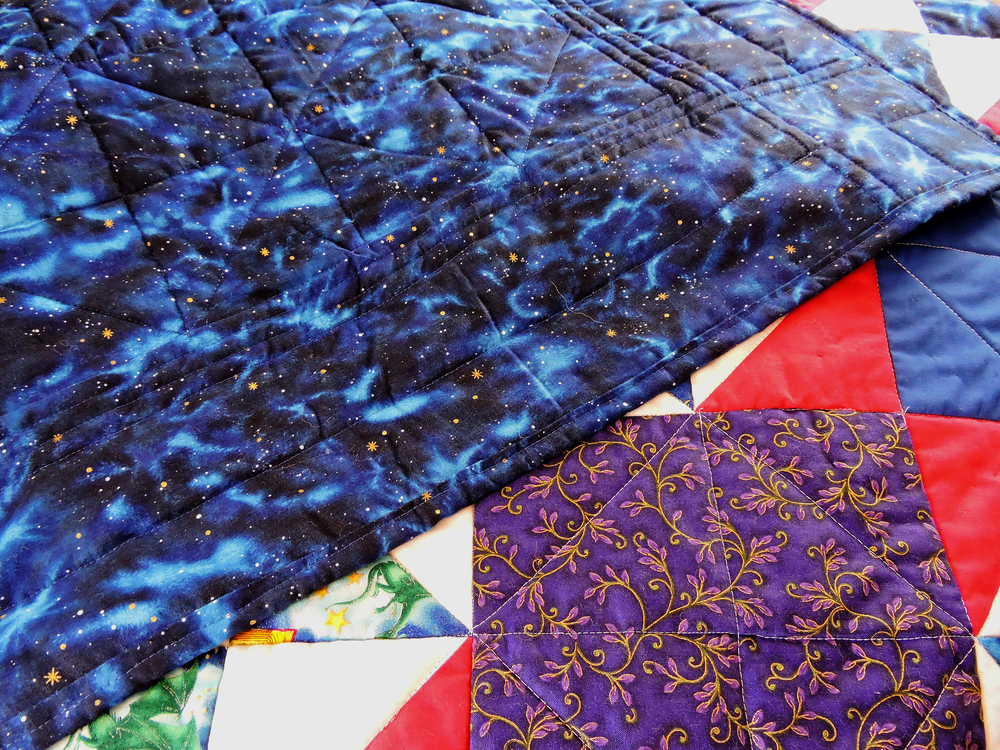
 always happy about going from a typical quilting cotton to a thick denim, especially when sewing the rows together, but I’m please with the result. The border on this quilt is made from an old fitted sheet from my twin bed. The back is a considerable amount of black cotton fabric that an Instagram/podcast-follower volunteered to send to me for the price of postage while clearing out some old stash from her craft room.
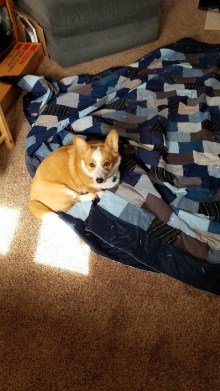 While I’m pleased with all the quilts I finished in 2018, this one holds a special place for me. Because it’s almost entirely made from recovered fabrics and destash, it’s seems to me like this is the closest to the spirit of historical quilting. There’s something very satisfying about that. I haven’t examined that too closely, but I think part of my aim in 2019 will be to work through stash. Instead of supplementing my stash with too many impulse fabric buys, I think I’d rather prefer recovering fabric from damaged/unmendable clothing as my main source of quilt materials. I don’t think I’ll ever be a capital-Q Quilter, but I think using quilting as a way to use recovered fabrics will be really satisfying.
 considerable hand pain. The simple shapes, the simple lines to sew and assemble, and the experimenting in machine quilting was a balm to my unhappy brain chemicals over many months in 2018. It was so important to me that I hosted an HST QAL in the Ravelry group for my podcast folks. A few people joined, which I’m grateful for, but it wasn’t very popular amongst my knitting viewers. I mean, I know it’s not for everyone, but I felt really encouraged when a couple of folks joined me.
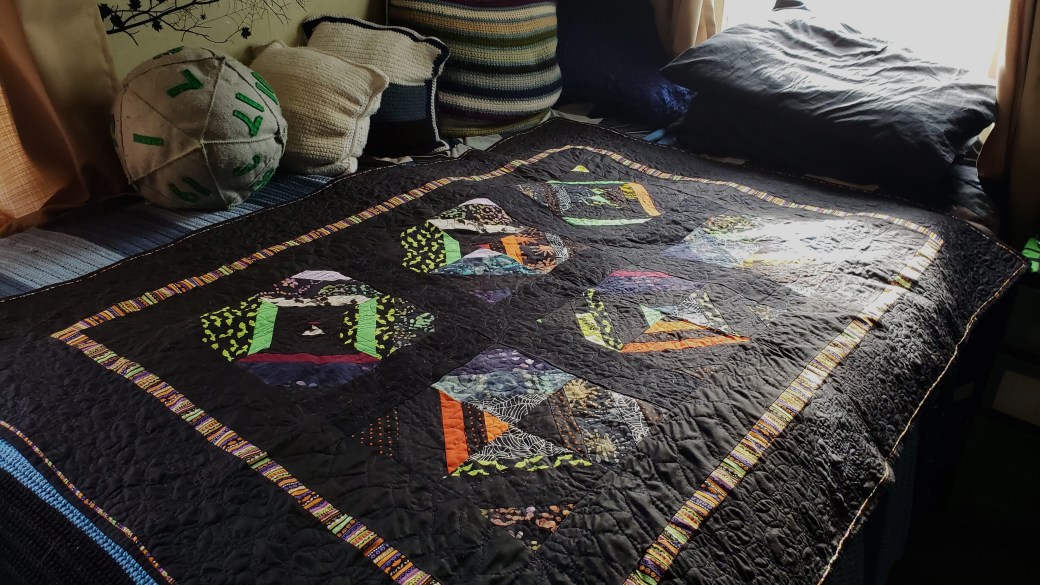

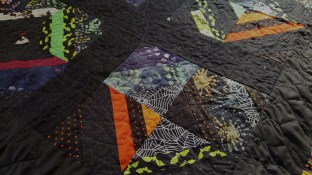 This quilt top was sitting around in my collection of quilt tops and I was reorganizing my fabrics at the same time, which happily resulted in finding that Halloween plaid backing fabric. I had originally purchased it to make a button down shirt, but I know myself better than I did and I’m not comfortable wearing shirts in full bright colors like that. Halloween plaid is perfect, however, for quilt backing fabric and within a few days, I had this quilt sandwich under the needle of my machine. It was done with freeform quilting – lots of experimenting and motif exploration – and I’m pretty pleased with how it turned out.















 Freakish Lemon